

Et in Arcadia Ego
The perfect cosmic soup combination of Poussin, Sleep Token, beauty, annihilation, and audacity.

There is a painting in the Louvre you’ve probably seen or walked by without really paying attention to it (I know I missed it, it is a gigantic museum after all). But I digress.
Nicolas Poussin, 1637. A group of shepherds in the sunlit landscape of Arcadia, which is to say paradise, which is to say the place where nothing bad has ever happened. They’re gathered around a tomb and one of them is tracing an inscription with his finger.
Et in Arcadia Ego.
Even in Arcadia, I exist.
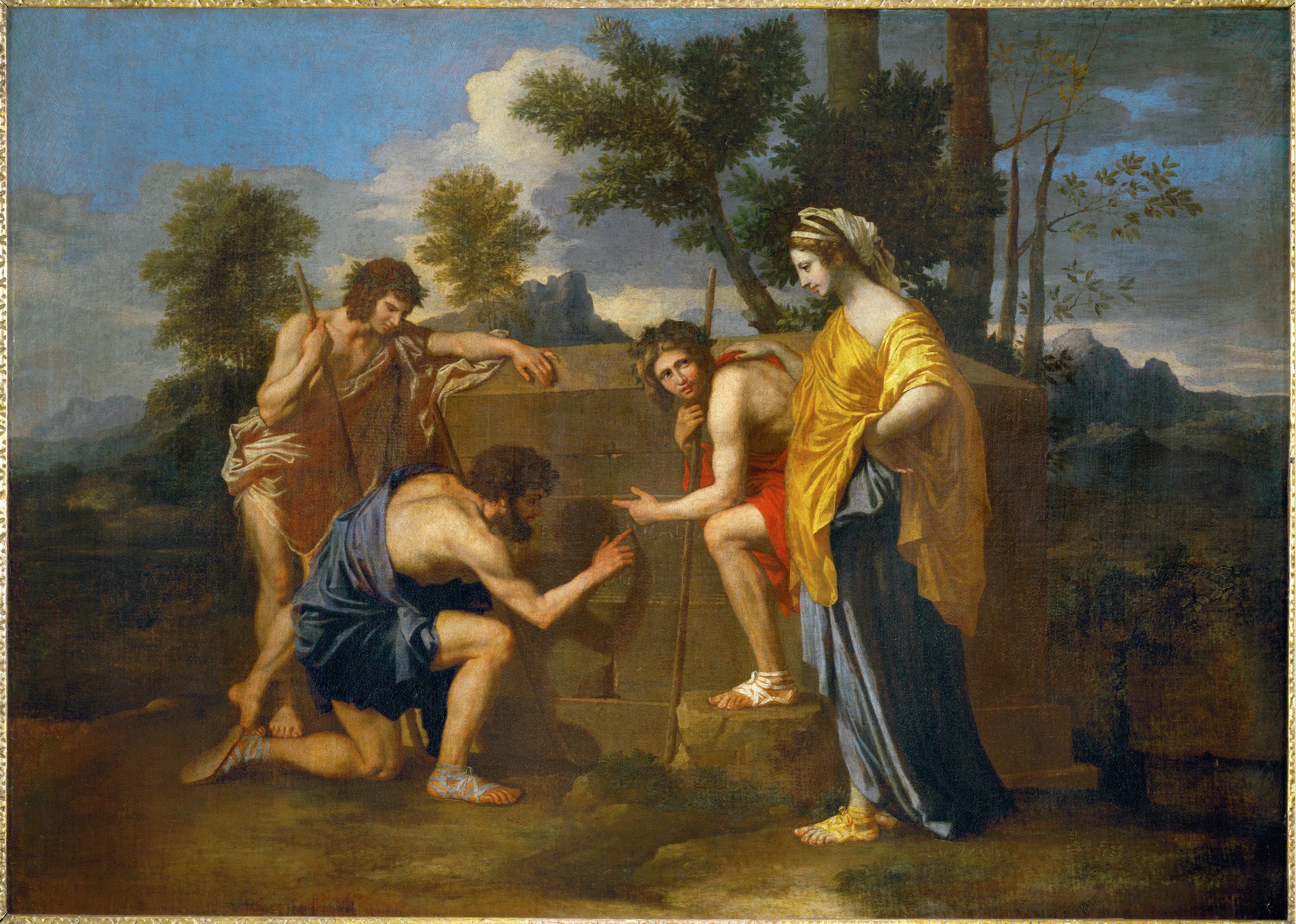
The inscription is not signed by some long-lost artisan. This is Death, speaking in first person from inside the stone, not in warning or threat, simply in statement.
It holds beauty and annihilation in the same frame and refuses to let either one win. The shepherds don't leave, they don't look away. They stand in the light and they read the words and they stay. And it's deliciously audacious.
We’ve spent about four hundred years trying to defang this thing. To turn it into a meditation on the preciousness of life, something consoling and soft. And it is that, technically, but only if you stop reading before you hit the verb. Ego: I, in present tense. Not I was here or I will come. I exist right now, while you’re standing in the bright light thinking you have more time than you have.
But Poussin didn’t paint the shepherds grieving or afraid, he painted them attending. The way you attend to something that is asking you a real question and waiting while you find the answer. Which is not a comfortable face to paint. It’s a lot easier to paint people looking sad.
If you’re anything like me, you immediately thought of Sleep Token’s last album Even in Arcadia.
If you know them, you already understand why. If you don’t: they’re a masked band from London who have built an entire mythology around devotion, ritual, and the cost of worshipping something that cannot love you back in kind. Their whole project centers emotional vulnerability, intense spiritual devotion, and an identity so deliberately constructed it becomes its own theology. They blur the lines between anonymity and ritual, the divine and the painfully human. On Even in Arcadia, the altar is in ruins and the offering feels less like worship and more like a confession.
The album’s title is, of course, a direct lift from this. Even in your greatest moments, even when you’re surrounded by success or beauty or divine love, death waits. The phrase “et in arcadia ego” is used to say that even in places as idyllic as Arcadia, some things are inevitable. The whole album is built on the question of what remains when the paradise you were promised turns out to contain the same rot as everywhere else.
What makes them interesting to me, as both a metalhead and someone who thinks a lot about objects and ritual and the act of making things, is the specificity of their framework. Their runic art and esoteric imagery draw from ancient mysticism, gothic romanticism, and occult aesthetics, but remixed for contemporary anxieties. In their hands, ancient signs become mirrors reflecting modern spiritual hunger — a longing for ritual and meaning amid the cultural collapse of grand narratives.
Metal, at its best, has always done this. It takes the things culture has decided to look away from like mortality and darkness, and it holds them in the light without flinching. The Poussin shepherds and the Sleep Token worshippers are doing the same thing: standing in the face of death without running.
Lately I’ve been thinking a lot about what it means to make something, be it a painting, a garment, or even a piece of writing, that holds that same double note of beauty and decay. Something that is genuinely beautiful but doesn't offer the consolation of prettiness without the weight underneath it.
Most things, especially most objects, are designed specifically to not do this. They’re designed to be pleasant, to slide past the eye without snagging on anything. I’m more interested, however, in the small but unmistakable sensation of being in the presence of something that was made with full awareness of what it is and what it isn’t. Because that awareness is now asking me to bring the same intentional thought.
Those are the pieces worth collecting.
And yes, memento mori has become a sort of collectable aesthetic category recently, complete with skulls and gothic flourishes. But the actual question Poussin’s painting is asking is: what do you do with the knowledge that death is always near? The clear-eyed, present-tense fact that time is moving regardless of your awareness of it. And secondly, what does a life look like when it’s organized around that fact rather than spent in avoidance of it?
Presence over distraction. Discernment over accumulation. Meaning over consumption. Depth, without abandoning joy. Ancient wisdom and the modern day-to-day you actually live in. A life that doesn’t require you to pretend the ordinary isn’t also sacred.
That’s the thread that runs through nearly everything I make and write here.
The shepherds didn’t leave Arcadia when they found the tomb. They stayed, because the tomb didn’t ruin Arcadia but completed it.
—
Sara
Founder & Creative Director, Double Kick
🖇️
Loved this? The best way to support my work (and help fund more pieces like this) is to become a paid subscriber.